

Research
Do animals perceive and produce rhythmic patterns? Do birds perceive sounds in a similar way to us humans? The Rhythm & Pitch group (R&P) studies the perceptual and productional vocal abilities of animals to answer broader questions of the evolution of language and musicality. We use the comparative approach to investigate whether animals in different taxa possess similar cognitive abilities to us humans. By studying species that are closely related to us humans, like primates, we can make hypotheses about how these traits evolved due to common ancestory, whereas by studying more distantly related species, like birds, we are able to to disentangle how similar abilties, such as vocal learning, lead to the evolution of these traits, e.g. convergent evolution.
Perception
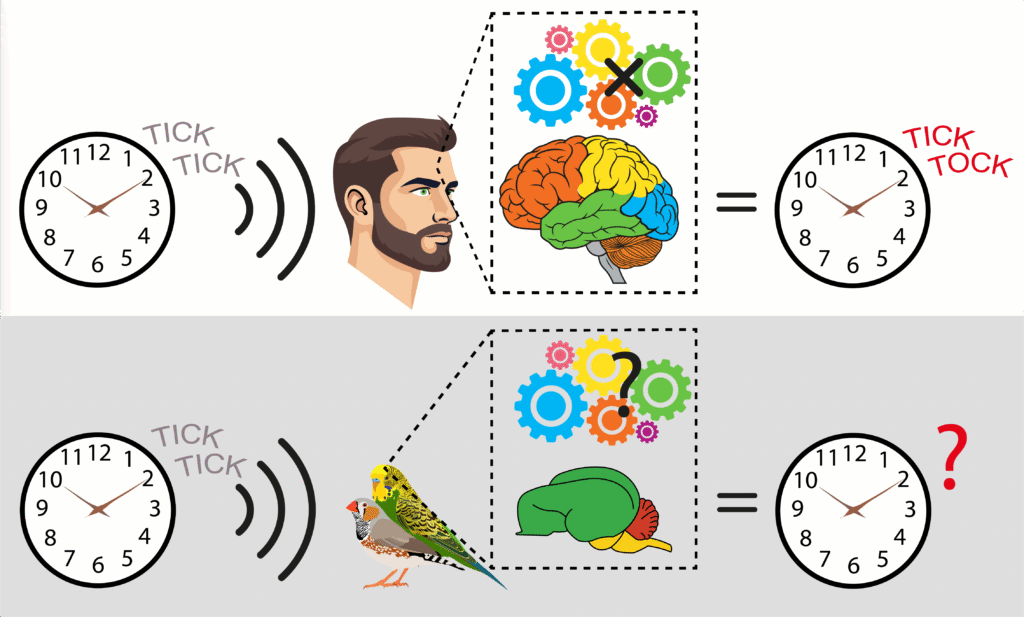
Auditory cognitive biases
Cognitive biases influences how we percieve sounds in our every day live. As humans, we perceive the tikking of a clock as “tick-tock” while the clock actually produces two identical. These small mismatches between what we hear and how we interpret it help us form patterns in the sounds around us. Is this an evolutionary old trait shared with other animals and could such biases have laid the foundation for the evolution of music and language? In a multi-species study, we explore the origins of cognitive biases in sound perception by comparing them in zebra finches, budgerigars, and marmosets.
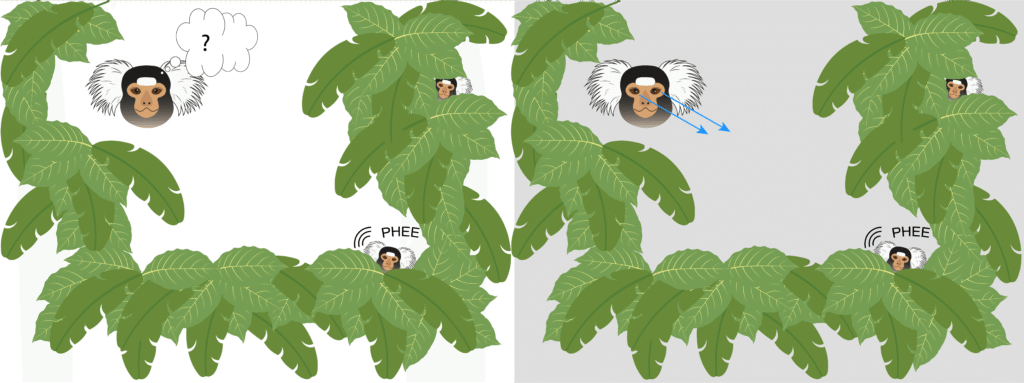
Sound localization
How do animals use acoustic information to locate stationary and moving objects? We study which processes are involved in dynamic decision making as sounds change over time and space. This research is part of the “Dynamates project” in which cognitive biology, cognitive neuroscience and computational modelling are combined. We specifically focus on how common marmosets (Callithrix jacchus) dynamically locate moving sound sources in real time.
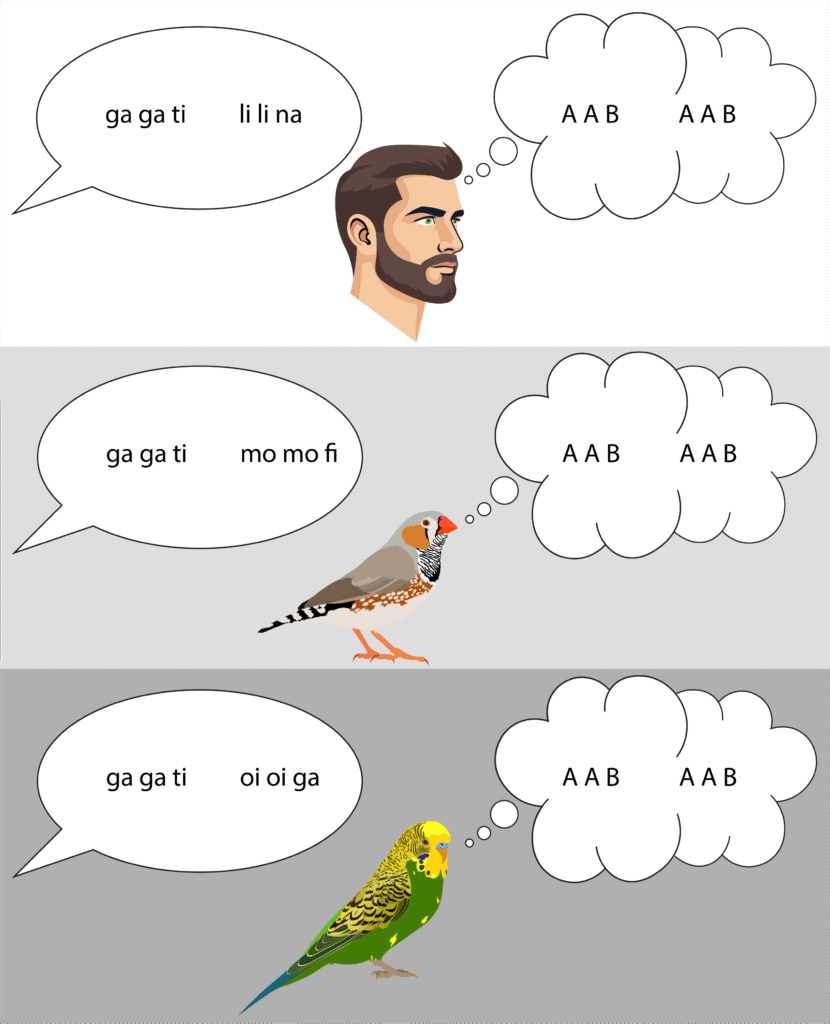
Pattern recognition
Humans easily detect and generalise patterns in the sounds around us, but what about other animals? In our research, we explore how different speices perceive and process sound sequences. For example, can songbirds recognise simple grammatical patterns (e.g. AAB) when listening to sequences of sounds? And can they transfer these rules to novel sounds with the same structure (e.g.CCD)?
An example of one of our studies can be found here:
Production
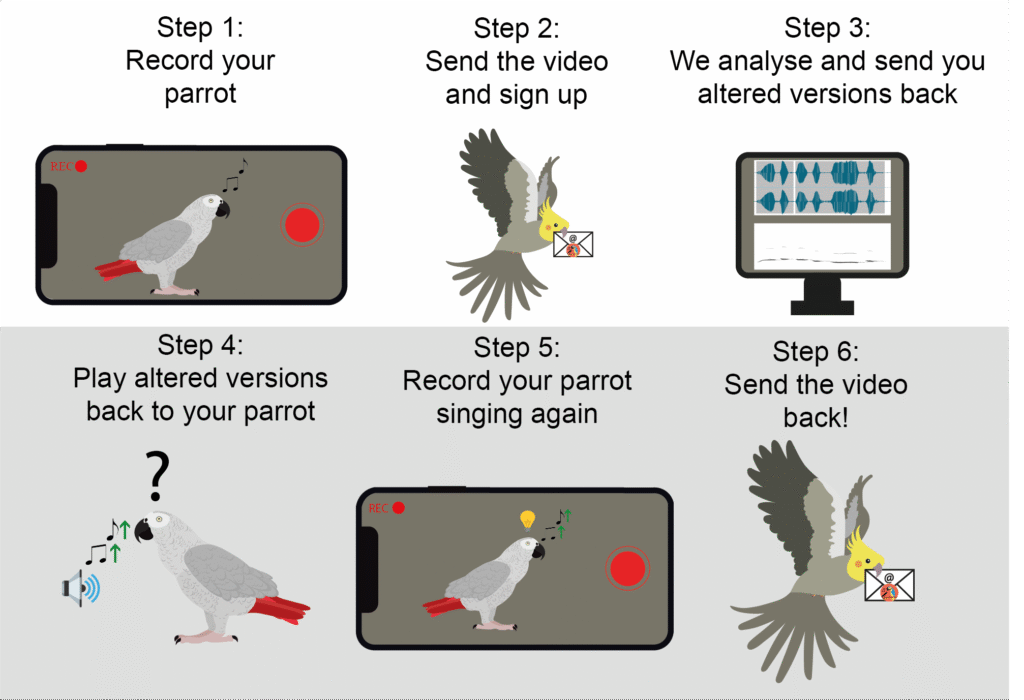
Relative pitch perception in parrots
Do parrots have a musical ear? In the Bird Singalong Project we use citizen science methods to study relative pitch perception in parrots. Relative pitch perception is the ability to perceive a melody as the same even if it’s transposed a few notes down or up. We are working together with parrot owners that have parrot that can sing popular songs. These parrot owners are asked to play an altered version (a few tones higher or lower than the original) to their parrots and record if the parrots will sing the song a few tones higher or lower than the original.

Rhythmicity in chimpanzees
Isochronous rhythms (patterns with equally spaced intervals) are considered to be the foundation of most rhythms found in human speech and music. These simple, steady rhythms also appear in the vocalizations of several bird species and some non-human primates. Do our closest living relatives the chimpanzees, produce such rhythmic patterns too? We study isochronous rhythmicity in the behaviour of zoo-housed chimpanzees. We focus both on rhythmic patterns in vocalizations as well as during motoric displays, such as drumming. For the latter, we use an artificial drum installed at Beekse Bergen Zoo, the Netherlands, to mimick the buttresses roots of trees that wild chimpanzees are known to drum on.
A recent publication about this topic is found here: https://doi.org/10.1098/rspb.2024.2200
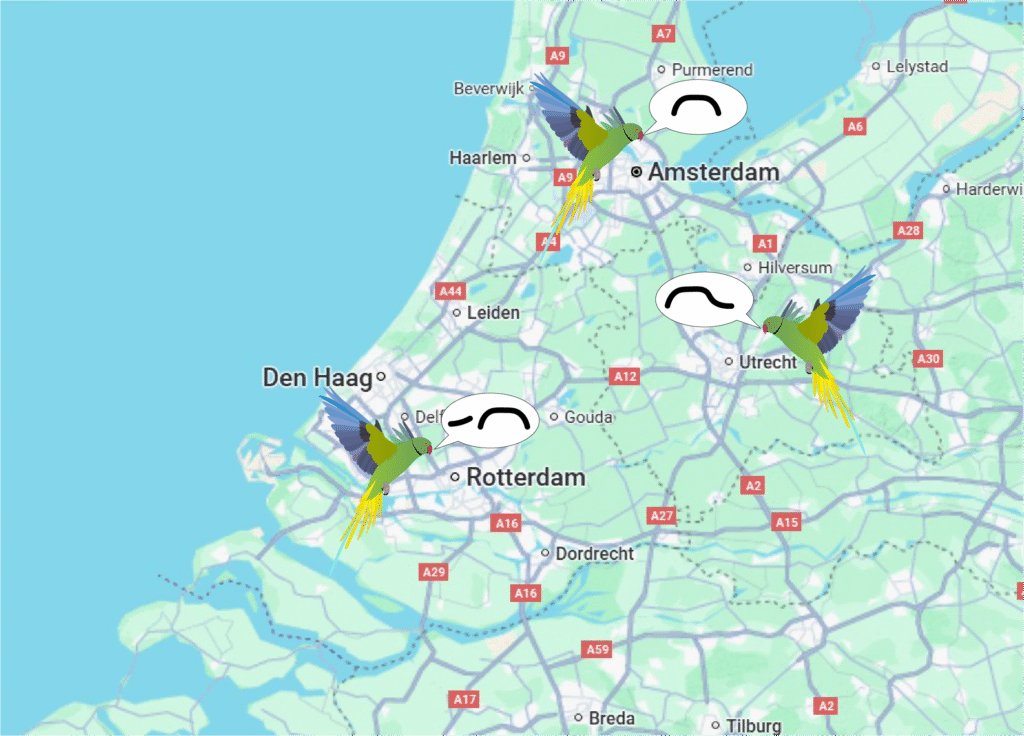
Dialects in parakeets
Dialects are found across almost all cultures. Evidence for dialects has also been found in several animal species ranging from birds to whales. Dialects in parrots have been documented only in a few parrot species thus far. In our research, we study whether populations of the invasive rose ringed parakeet (Psittacula krameri)living in different cities in the Netherlands have distinct dialects. By using both active and passive sound recording methods, we can track geographical variation in both urban and rural environments. This is particularly interesting between Dutch cities which are relatively close together.